









Buellia erubescens
 Uncommon
 Uncommon
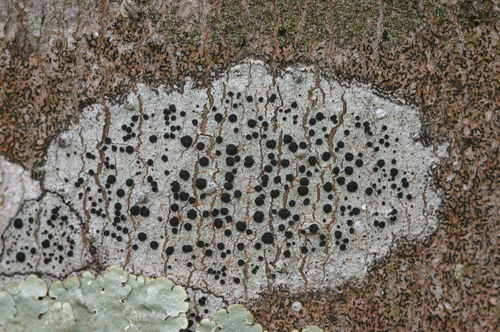
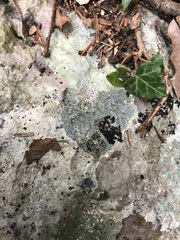
Buellia erubescens is a species of lichen commonly found in various regions, including the Comunidad Valenciana. This lichen is part of the fungal genus Buellia and is recognized for its distinctive characteristics and ecological contributions.
Identification Features:
- Color: Typically, Buellia erubescens displays a greyish to brown hue. Its surface may appear somewhat dull or have a slight sheen, depending on the environmental conditions.
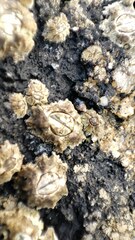
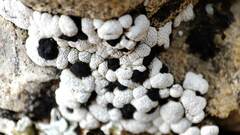
- Thallus: The thallus is crustose, meaning it forms a crust-like layer that adheres closely to the substrate, often rocks or bark.
- Apothecia: The fruiting bodies, known as apothecia, are usually black and are scattered across the thallus surface. They have a disc-like appearance, often slightly convex.
- Reactivity: The species can exhibit a characteristic color change to red when exposed to certain chemical reagents, a phenomenon alluded to in its name "erubescens."
Habitat and Ecology:
- Substrate: Buellia erubescens primarily colonizes siliceous rocks, but can also be found on calcareous substrates. It occasionally grows on tree bark, adapting to various microhabitats.
- Distribution: Although it is well-distributed across temperate regions, the Comunidad Valenciana offers ideal conditions for its growth due to the Mediterranean climate and diverse geology.
- Role in Ecosystem: Like other lichens, Buellia erubescens plays a vital role in ecosystems by contributing to soil formation, providing nutrients through nitrogen fixation, and serving as an indicator of air quality.
This lichen species is an essential component of the natural landscape, contributing to the biodiversity and ecological health of its habitats in the Comunidad Valenciana. Observing and studying Buellia erubescens offers insights into the rich ecological tapestry of the region.


 360° Views
 Videos
 Mountain bike
 Vall Agenda
 Weather Stations
 Time Travel
 Flora and Fauna