







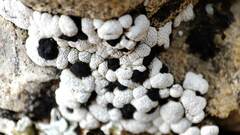

Strobilurus tenacellus
 Uncommon
 Very rare
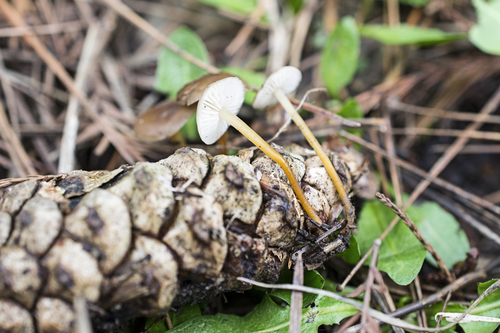
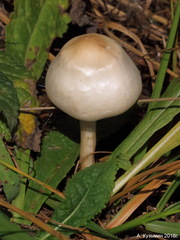
Strobilurus tenacellus is a small and intriguing mushroom, commonly found in coniferous forests. It is especially known for its unique relationship with pine cones, often appearing on them during the spring season. This species is scientifically classified under the division Basidiomycota, and belongs to the family Physalacriaceae.
Characteristics of Strobilurus tenacellus include:
- Cap: The cap of this mushroom is small, typically ranging from 1 to 2.5 cm in diameter. It starts off as convex and eventually flattens, often displaying a slight depression at the center. The color ranges from light brown to grayish, becoming more pale towards the edges as it matures.
- Gills: The gills are crowded and attached to the stipe, often appearing whitish or pale cream in color.
- Stipe (Stem): This is slender and elongated, measuring about 2 to 5 cm in height. It is generally cylindrical and the color is similar to the cap but may have darker tones towards the base.
- Spore Print: White in color, which is typical for many mushrooms.
- Habitat: Strobilurus tenacellus is commonly found in clusters on fallen pine cones, primarily associated with pines. It thrives in moist, forested areas where pine cones are abundant.
Although not widely known for culinary use due to its small size, Strobilurus tenacellus has a unique ecological role. It helps in the decomposition of pine cones, releasing nutrients back into the forest ecosystem. In the Comunidad Valenciana, it can be found in suitable pine forest habitats, providing a fascinating example of mycological diversity in the region.


 360° Views
 Videos
 Mountain bike
 Vall Agenda
 Weather Stations
 Time Travel
 Flora and Fauna