










Little owl
Athene noctua Very common
 Uncommon
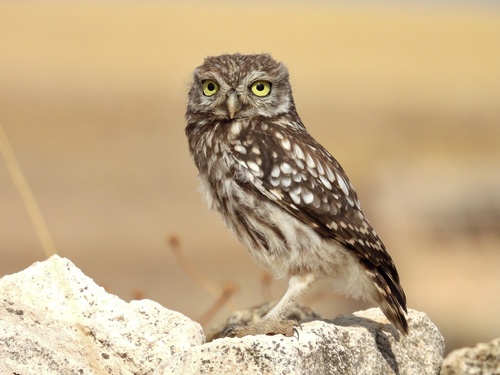
Aves Athene noctua, commonly known as the Little Owl or Mochuelo Europeo in Spanish, is a small bird of prey that inhabits the Comunidad Valenciana, among other regions across Europe and Asia. This bird is particularly notable for its distinct appearance and behaviors.
- Appearance: The Little Owl is a small bird, about 21-23 cm in length, with a wingspan of 54-58 cm. It is characterized by its stocky build, rounded head with no ear tufts, and striking yellow eyes. Its plumage is mottled brown and white, providing excellent camouflage in its natural environment.
- Habitat: In the Comunidad Valenciana, the Little Owl is commonly found in open country areas, such as farmland, olive groves, and semi-open forests. They favor areas with plenty of perches and nearby open land for hunting.
- Diet: This species primarily feeds on insects, small mammals, birds, and amphibians. Its diet can vary seasonally based on availability, adapting well to different types of prey.
- Behavior: Athene noctua is known for its active diurnal and crepuscular habits, which is somewhat unusual for owls. They are often seen perched on posts or rocks, using these vantage points to spot and swoop down on prey. Their flight is characterized by rapid wingbeats and gliding.
- Breeding: The breeding season typically starts in early spring. Little Owls nest in natural cavities, old buildings, or man-made structures and the female lays a clutch of 3-5 eggs that she incubates for about 28-29 days.
- Conservation Status: Currently, the Little Owl is classified as one of least concern due to its wide distribution, though habitat loss and increased agricultural use pose potential threats.
These captivating birds are an integral part of the biodiversity in the Comunidad Valenciana, playing a crucial role in controlling insect and rodent populations.


 360° Views
 Videos
 Mountain bike
 Vall Agenda
 Weather Stations
 Time Travel
 Flora and Fauna