








Ivy broomrape
Orobanche hederae Uncommon
 Very rare
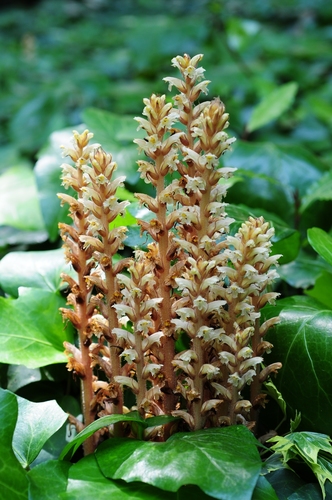
Orobanche hederae is a unique and fascinating plant species found in the Comunidad Valenciana, among other regions. Known locally as "Jopo de hiedra", this plant contributes to the diverse flora of the area, and is particularly notable for its parasitic nature.
- Appearance: Orobanche hederae is characterized by its lack of chlorophyll, which gives it a distinctive appearance compared to other plants. It has a tall, spindly flowering stalk, often ranging from a pale yellow to a purplish hue, topped with dense clusters of tubular flowers.
- Habitat: This plant is typically found in areas where its host plant, Hedera helix (common ivy), thrives. It commonly grows in shaded and moist environments where the ivy is abundant.
- Parasitism: Unlike most plants, Orobanche hederae does not rely on photosynthesis for energy. Instead, it is a holoparasitic plant, drawing nutrients from its host, the ivy, through specialized structures known as haustoria.
- Reproduction: The plant produces seeds that are spread by wind, allowing it to colonize new areas where its host plants are present.
- Significance: Orobanche hederae plays a unique role in the ecosystem, contributing to the biodiversity of the Comunidad Valenciana. Its parasitic nature makes it a point of interest for both botanists and nature enthusiasts.
While rarely seen due to its specific growth requirements, Orobanche hederae is a remarkable example of the adaptation and survival strategies found in the plant kingdom.


 360° Views
 Videos
 Mountain bike
 Vall Agenda
 Weather Stations
 Time Travel
 Flora and Fauna