








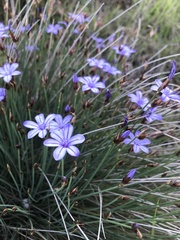

Ribwort plantain
Plantago lanceolata Common
 Very common
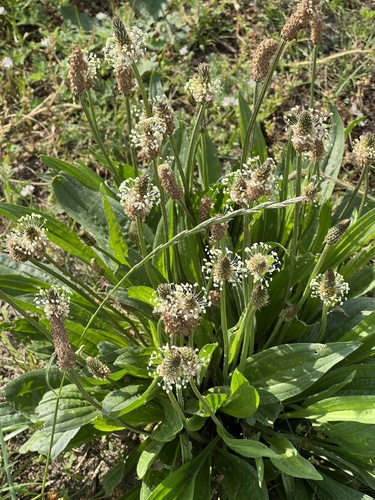
Plantago lanceolata, commonly known as English plantain or narrowleaf plantain, is a perennial herbaceous plant belonging to the family Plantaginaceae. In the Comunidad Valenciana, it is also referred to as llantén menor.
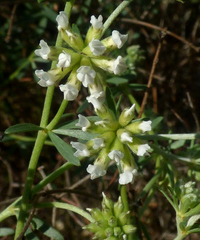
This plant is easily identifiable by its rosette of long, narrow leaves which are lance-shaped, hence the name lanceolata. The leaves have five to seven parallel veins and can grow up to 30 cm in length. The flowering stems are leafless, elongated, and can reach heights of 10 to 50 cm. At the top, they bear compact, cylindrical flower spikes that are about 5 cm long and consist of numerous tiny flowers.
Some key characteristics of Plantago lanceolata include:
- Leaves with deeply grooved veins and a slightly hairy surface.
- Brownish to grey-green flower spikes.
- A preference for sunny locations and well-drained soils, although it is adaptable to various conditions.
- Common habitats include grasslands, roadsides, and meadows.
Ecological and Medicinal Value:
In terms of ecology, Plantago lanceolata plays a role in the food web by providing a source of nectar for pollinators such as bees and butterflies. Additionally, its leaves are a preferred food for the larvae of certain butterfly species.
Traditionally, llantén menor has been used for its medicinal properties. It is known for its anti-inflammatory and wound-healing capabilities, often utilized in folk medicine to treat minor skin injuries, insect bites, and respiratory conditions.
This resilient and ubiquitous plant is not only an essential component of the flora in the Comunidad Valenciana but also an integral part of the region's natural heritage.


 360° Views
 Videos
 Mountain bike
 Vall Agenda
 Weather Stations
 Time Travel
 Flora and Fauna